Jimeng's platform
VerifiedJimeng (即梦) is ByteDance's official AI creative platform, integrated with Douyin (Chinese TikTok) and offering image and video generation to a massive consumer base
HappyHorse and Jimeng share indirect ties to the ByteDance talent ecosystem, but HappyHorse is an anonymous benchmark-topper while Jimeng is ByteDance's official consumer video generation platform integrated into Douyin.
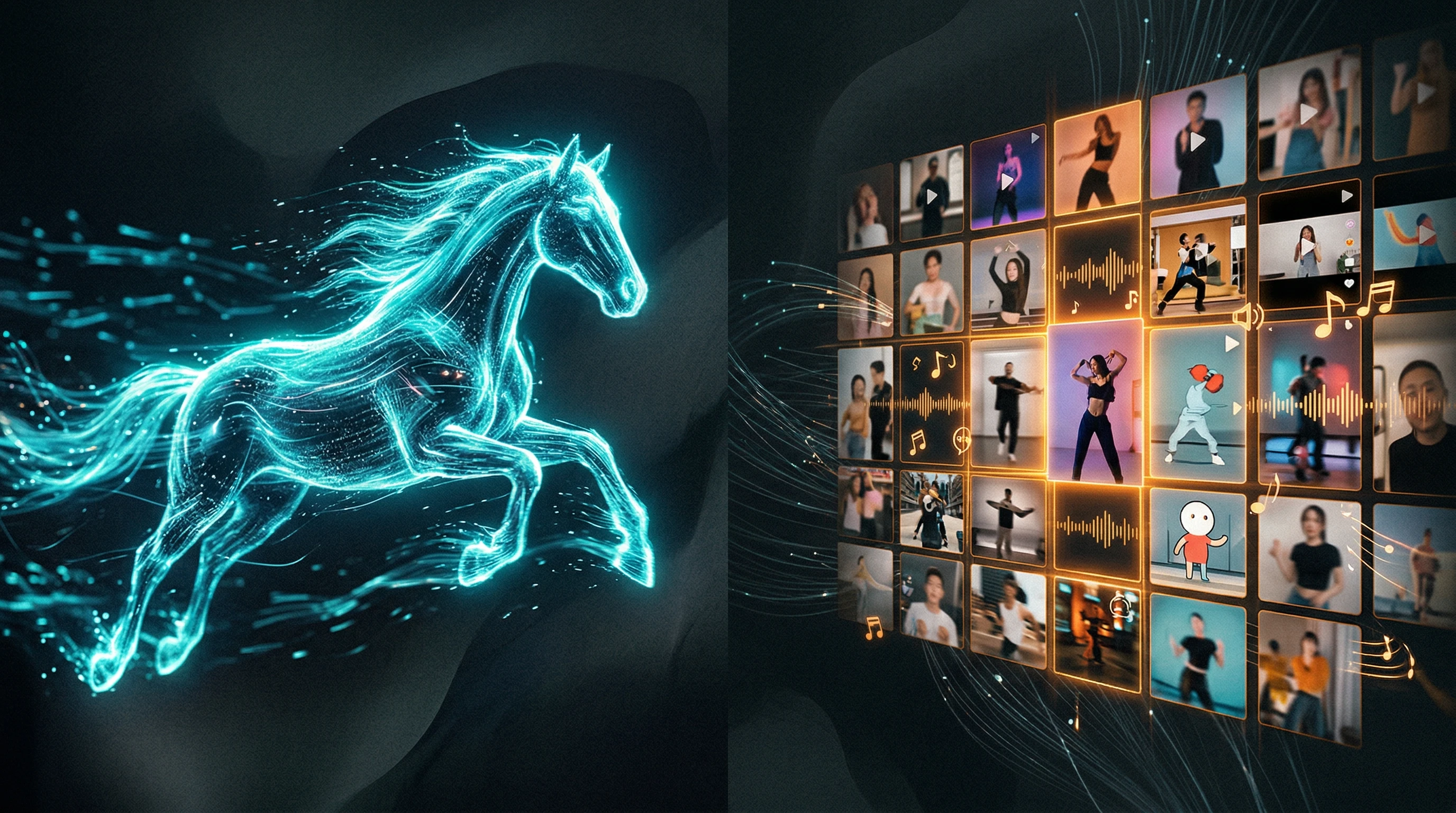
Key facts
Jimeng (即梦) is ByteDance's official AI creative platform, integrated with Douyin (Chinese TikTok) and offering image and video generation to a massive consumer base
HappyHorse's suspected creator Zhang Di previously worked at Kuaishou (Kling), not ByteDance; the connection is through the broader Chinese AI video talent ecosystem rather than direct ByteDance affiliation
Jimeng has direct access to Douyin's hundreds of millions of users, giving it unmatched distribution in China; HappyHorse has no confirmed distribution platform
Get 50+ tested AI video prompts, comparison cheat sheets, and workflow templates delivered to your inbox.
Mixed signal
Comparison framing is valid, but specific performance claims should be limited to what public evidence supports.
Readers should expect careful wording here because public reporting confirms the topic, while some product details still need cautious treatment.
HappyHorse and Jimeng represent fundamentally different approaches to AI video. Jimeng is ByteDance's consumer play — deeply integrated into Douyin, optimized for content creators who need quick video generation within an existing social platform. HappyHorse is a pure performance play — an anonymous model that topped benchmarks and generated buzz through quality alone. If you are a Douyin creator, Jimeng is already in your workflow. If you are evaluating AI video models on raw output quality, HappyHorse has the stronger signal. These models serve different purposes more than they directly compete.
HappyHorse's 15B-parameter transformer clearly outperforms Jimeng on the Artificial Analysis leaderboard. But this comparison requires context: Jimeng is optimized for fast, good-enough generation within a social media workflow, not for producing benchmark-winning showcase clips. HappyHorse targets the quality ceiling; Jimeng targets the practical floor for mass content creation.
Jimeng has a distribution advantage that almost no AI video model can match: direct integration with Douyin, one of the largest short video platforms in the world. Users can generate and publish without leaving the app. HappyHorse has no equivalent distribution channel. In the consumer AI space, distribution often matters more than raw quality.
Jimeng is designed for high-volume consumer use, meaning fast generation times and infrastructure optimized for scale. ByteDance's engineering resources ensure the system can handle Douyin-scale traffic. HappyHorse's throughput and infrastructure scale are unknown.
Jimeng excels for: short social content, meme-style videos, Douyin trend participation, quick creative generation. HappyHorse excels for: high-fidelity video output, showcasing AI capability, potential professional use. The overlap between these use cases is smaller than it might seem.
The interesting narrative here is the broader ByteDance talent ecosystem. ByteDance's Seedance 2.0 was the model HappyHorse displaced on the leaderboard. Jimeng is ByteDance's consumer product. And HappyHorse's suspected creator Zhang Di came from Kuaishou — a ByteDance competitor in the short video space. This is less about direct competition between HappyHorse and Jimeng, and more about the gravitational pull of talent across China's AI video industry.
For the direct ByteDance model comparison, see HappyHorse vs Seedance. For the Kuaishou connection angle, read HappyHorse vs Kling. For the full market view, check Best AI Video Models.
FAQ
Not directly. The connection is indirect — HappyHorse is suspected to involve Zhang Di, who worked at Kuaishou (a ByteDance competitor), and HappyHorse may be backed by Alibaba's Taotian Group. The ByteDance link in this comparison is Jimeng, which is ByteDance's own product. The two models come from different organizations.
Jimeng is primarily designed for the Chinese market and is tightly integrated with Douyin. International access is limited. For users outside China, neither Jimeng nor HappyHorse offers straightforward access, though HappyHorse's situation is less clear.
HappyHorse ranks significantly higher on the Artificial Analysis leaderboard. Jimeng's strength is not raw benchmark performance but rather its integration into ByteDance's content ecosystem, making it easy for Douyin creators to generate video content within their existing workflow.
Recommended tool
Powered by Elser.ai — works independently of any model discussed above.
Try AI Image Animator